 |
|
 |
|
 |
|
 |
|
 |
|
 |
|
 |
|
 |
|
 |
|
 |
|
 |
|
 |
|
 |
|
 |
|
 |
|
 |
|
 |
|
|
Material on the
Authenticity
by Shaikh ‘Abdur-Raheem Green All praise is due to Allah, we praise Him and we seek his help and ask His forgiveness. We seek refuge with Allah from the evil of our selves and from the evil results of our actions. I testify that Allah alone is worthy of worship and that Muhammad is His slave and final Messenger. May Allah’s salawaat (peace and blessings) be upon the last and final messenger Muhammad, his family and his followers. Ameen! To begin: The best discourse is the book of Allah, and the best way is the way of Muhammad, and the worst of the matters in the religion are those newly introduced innovations, for every innovation in the religion is misguidance, and every misguidance is going astray and every going astray is in the Hellfire. I have embarked on my commentary on the The Economist magazine’s survey “Islam and the West” (large insert in the August 6, 1994 issue) after some considerable deliberation, and find myself confronted with a considerable task, and indeed Allah is the best of helpers. Brian Beedham is able to rely on what Noam Chomskey calls “manufactured consent”. While dictatorships use force in order to achieve consent from the people and prevent opposition, “democracies” manufacture consent through the media by using it to providing a particular world view which conforms to the interests, by and large, of the ruling elite. He is able to get away with a short, condensed, article because he doesn’t need to prove much of what he is saying, he only has to repeat the prefabricated conventional platitudes. For example, when he talks the Algerian Muslims as “a singularly intransigent bunch of Islamic rebels, fundamentalists of the most bloody minded sort” he doesn’t have to prove it, because the establishment has already ensured that people believe this is the case. In fact the statement in not at all true. The Algerian fundamentalists proved willing to go to elections and seek a peaceful way re-establish the Islamic Sharee’ah . Recent events, such as the meeting of the opposition groups, including the “rebel fundamentalists”, in Rome, calling for talks and a return to free elections - which was even supported by the French government and was rejected by the Algerian government - shows that it is the Algerian government that has proved bloody minded. In spite of such obvious discrepancies Mr. Beedham is able to get away with it because consent has already been manufactured that the fundamentalists are rebellious and bloody minded. Similarly he never feels he has to prove that democracy is an advantage, it is taken almost completely for granted, knowing his audience is already “captive” so as to speak. In the age of the “sound-bite” (or perhaps in this case “word-bite”), opposing the conventional wisdom is not easy, for what the likes of Mr. Beedham can say in a sentence opposing it would take a book. Even then it would be of doubtful effectiveness, for opposing the norms of society is perhaps one of the hardest paths to take for an instinctively societal creature like ourselves. Thus I shall be writing a series of letters, and not just one, thus enabling me to break down the commentary into more manageable pieces. I shall also refer certain topics to appendices, which may include video and audio tapes. Islam: An Idea! Of course no Muslim could accept Islam merely as an idea. As the survey itself mentions, Islam is based on the "word of God, revealed syllable by syllable to Muhammad fourteen hundred years ago" (p.4 c.2). Thus it is no mere idea, rather it is the idea, the ideology, the truth, exclusive of all others. As the Qur’an states: "Indeed the religion before Allah is Islam" . . . "Whoever wishes for a way of life other that Islam, never will it be accepted from them and in the hereafter they will be amongst the losers" (Surah Al Imraan 3:85). The religion has been completed and perfected, and has no need for alteration or adjustment: "This day we have completed your religion for you and perfected our favour upon you and chosen for your way of life Islam" (Surah Al Imraan 3:85). The Prophet, peace be upon him, also said: "There is not one thing that shall bring you closer to the Paradise and away from the Fire without me having informed you of it, and there is not one thing that will take you away from paradise and towards the fire except that I have warned you about it." It is indeed true that Islam does not allow its followers to draw a distinction between the "inner" and "outer" aspects of life, between belief and actions, religion and politics, because in reality such distinctions are totally fallacious. Man’s beliefs are the foundations and prime motivators for actions, for what is held to be true on the inside must manifest itself outwardly. Indeed the very first task given to Muhammad, peace be upon him, was to correct the false beliefs. It was not that the pagan Arabs did not believe in Allah, or God the Creator. In fact the Qur’an tells Muhammad, peace be upon him,: "If you ask them who sends down rain from the sky, and gives life therewith to the earth after its death? They would certainly say ‘Allah!’ Say: ‘All the praise and thanks be to Allah!’ Nay! Most of them have no sense" (Surah al-Ankaboot 29:63). "Say: ‘Who provides for you from the sky and from the earth? Or who owns hearing and sight? And who brings out the living from the dead and the dead from the living? And who disposes the affairs?’ They will say: ‘Allah.’ Say: ‘Will you not them be afraid of Allah’s Punishment (for setting up rivals in worship with Allah)?’” (Surah Yunus 10:31). Indeed the pagan Arabs used to worship Allah, pray to Him and sacrifice to Him in times of need and distress, as did the Jews and Christians, and they even claimed to love Him, but Allah rejected all of this from them and referred to them as senseless, and astray, and as disbelievers. So this is the reality concerning most of the men and jinn , that they claim to believe in Allah, and worship Allah, but what they believe about Him is incorrect, and the way they worship Him is incorrect . . . "Most of them do not believe in Allah except while joining partners with Him" (Surah Yusuf 12:106) . . . and it’s manifestations are many and the evil consequences numerous. All of this has one common cause, or origin, and that is thinking and speaking about Allah without knowledge, and thus ascribing to Him that which should not be ascribed to Him, such as sons, or daughters, or human qualities and weaknesses, or claiming that some of the creation possess His powers and abilities, or by claiming that He, the Majestic, is pleased by some action that in fact angers Him, or that He is angered by some action that in fact pleases Him. So thus the idol worshippers call upon that which can neither benefit nor harm them, and the Christians call upon Jesus, and the Jews believe their racial origins guarantee His good pleasure, and those who believe that power, wealth and the such are means of success; all have put their faith and trust in something vain. This in itself is a great evil, for they have only wasted their time and effort, yet this is least of the evil consequences. As for that which is most severe . . . those who have fallen into associating partners with Allah have earned His anger and wrath, and upon them shall fall humiliation in this life and a most terrible fate in the next: "Surely Allah will not forgive as-shirk (the association of partners with Him), but He forgives sins less than that of whomever He wishes" (Surah an-Nisa’ 4:48). So "as-shirk", or ascribing partners to Allah (in whatever form it may take) is the unforgivable sin, because it is in reality the source of all evil, the greatest injustice, the worst oppression and wrongdoing. For if one is unafraid of speaking about Allah without knowledge, and this is a knowledge unattainable except through Him, for He is the best knower of Himself and His will, and that which pleases and displeases Him, then about what and about whom will one be afraid of speaking about ignorantly? For truly, as is obvious to anyone witnessing the destructive forces of nature, and untold misfortunes and miseries over which Allah alone has ultimate power and control, both in this life and the next, Allah is the most terrifying and most worthy of being feared. And also anyone witnessing the miraculous order, and precision, and symbiosis within the earth and universe, must realize the unparalleled knowledge and wisdom of its Creator. So if one is heedless of transgressing the laws of Allah, and thinks them of little or no importance, or worse considers them bad, evil, and outdated, then what of the laws conceived in the limited minds of men? If one is ungrateful to his Lord, the provider of all, then of what little consequence to such a one is ingratitude to the creation? If one denies the rights and dues of Allah, which are the most worthy of being fulfilled, then what rights and dues will such one be fearful of denying then? Thus imagine the case of a worker in a company run by yourself , who believes you are the lavatory cleaner, and the lavatory cleaner is the director! Would there not be evil results? Would you tolerate such a person? If so, for how long? Now envisage this fool teaching this to others, and insisting on it, so that the majority of the company came to believe it, ignoring your orders and prohibitions, and inventing them for themselves, and making their guide the lavatory cleaner who is moreover deaf and dumb! The true cause of the evils that beset mankind are disbelief, sinfulness and ingratitude to Allah: “And whatever of misfortune befalls you, it is because of what your hands have earned. And He pardons much” (Surah as-Shura 42:30). “Evil has appeared on the land and sea, because of what your hands have earned. That Allah may make them taste a part of that which they have done, in order that they may return” (Surah ar-Rum 30:41). As the saying of the Prophet, peace be upon him,: "There is none who has a greater sense of ghira (a feeling of great fury and anger when one’s honour and prestige is injured or challenged) than Allah, and so He has forbidden shameful deeds and sins. And there is none who likes to be praised more than Allah does" (Reported in Saheeh Al Bukhari). Allah is more infuriated by the disobedience of His slave than a man of honour is finding his wife fornicating with another man. So how is His fury with those who insult Him by ascribing rivals, and partners with Him, while He is glorious above such things! And the evil consequences are not limited to this life: "Verily, those who disbelieved, and die while they are disbelievers, the whole earth full of gold will not be accepted from anyone of them even if they offered it as a ransom. For them is a painful torment and they will have no helpers" (Surah Al Imran 3:91). The Prophet, peace be upon him, explained: "On the day of judgement a disbeliever will be asked: ‘Suppose you had as much gold as to fill the earth, would you offer it to ransom yourself from the hell-fire?’ He will reply: ‘Yes!’ Then it will be said to him: ‘You were asked for something easier than that, that you should join none in worship with Allah, and submit yourself to Him, but you refused’" (Reported in Saheeh al-Bukhari). Indeed the message of all the prophets is one and the same: "Verily, We have sent to every nation a messenger saying: ‘Worship Allah and avoid false objects of worship’" (Surah an-Nahl 16:36) and indeed this is the very purpose for which Allah created mankind: "I did not create the jinn and mankind except for My worship" (Surah ad-Dhaariyaat 51:56). So “as-shirk” (i.e. ascribing partners to Allah) is in contradiction to that reason for which Allah has created us, and the purpose for which we exist, which is to choose to single out Allah for worship, avoiding all false deities, and to worship Him completely, with sacrifice, supplication, submission, subjugation, obedience and compliance, and with love, fear, hope, trust and reliance upon Him, seeking only His pleasure and not the admiration of His creatures, and to do all of that according to that which was revealed to His last and final Messenger Muhammad, peace be upon him,, and not according to whims and desires and mere conjecture. Furthermore, and of immediate relevance to the discussion, are those qualities, unique to Allah, that single Him out, such as "al-Hakim", the Judge; "al-Hakeem", the Wise; "al-’Aleem", the All Knowing and "as-Shariy", the Legislator. Not only is Allah the Creator and Controller and Sustainer, but also the sole possessor of the wisdom and knowledge to legislate for mankind and to determine what is good and what is evil, what is right and what is wrong, what is lawful and what is prohibited, and thus what laws we should judge by, what social, economic and political system we should utilize . . . "And no partner in legislating has He-He is alone" (Surah al-Kahf 18:60) . . . "Indeed, the ruling is Allah’s" (Surah Yusuf 12:40). Allah admonished the Jews and Christians, and called them disbelievers, for " . . . taking their priests and rabbis as lords besides Allah" (Surah at-Tawbah 9:31). The Prophet, peace be upon him, went on to explain that the priest and rabbis "made lawful that which Allah had made unlawful, and made unlawful that which Allah had made lawful and the people accepted it...So that was their (i.e. the people’s) worship of them.” Thus to ascribe legislative power to people is a clear and obvious form of disbelief, and “shirk”, or setting up rivals to Allah, and is the unforgivable sin, and a contradiction of the purpose of creation. If Allah blamed the people from the Jews and Christians for accepting from those among them who were learned in the Scripture and Divine legislation changes and alterations, and the making the forbidden allowed and visa versa, as we see them doing until this day, then how about those who accept such actions from every Tom, Dick and Harry, who have no scripture, and no wisdom and only pure speculation, whims and desires, as is the case of Democracy?!? So the The Economist magazine’s survey admits that Islam makes no distinction between outward and inner, private and public life, yet goes on to suggest Muslims should abandon this, and adopt the ways of the worst error: disobedience to and rebellion against Allah, and commit the unforgivable sin of ascribing partners to Him. Truly Allah speaks the truth when He says: "Never will the Jews or the Christians be satisfied with thee unless thou follow their form of religion” (Surah al-Baqarah 2:120) and we seek refuge with Allah from that, for surely we would be of the losers. To Clash or Not To Clash? Will there be a confrontation between Islam and the West? Mr. Huntington’s clash of civilizations claims “yes”, but the survey is "not convinced". It is true that the world of Islam and the West have more in common with each other than they do with the Confucian and Hindu ones, but in reality both Mr. Huntington’s and Mr. Beedham’s comparisons are unhelpful in understanding the reality of the matter. What Mr. Beedham’s admits are important differences (Westerners not believing that God dictated the Qur’an and Muslim’s not believing the Jesus is the son of God) are in fact irreconcilable differences, at least from the Muslim stand point . . . “And they say the Compassionate (i.e. Allah) has taken to Himself a son. Certainly you utter a disastrous thing, whereby the heavens are almost torn asunder, and the earth split open and the mountains crumbles to ruin, that you ascribe to the Compassionate a son! When it is not befitting the majesty of the Compassionate that He should choose a son. There is none in the heavens or the earth but comes to the Compassionate as a slave” (Surah Maryam 19:88-93). Islam does not regard Christians who claim that Jesus is God, or the Son of God, as “monotheists” any more than Hindus who claim that Krishna is a “manifestation of God” or Buddhists who claim that Buddha is God. All of this is disbelief and polytheism. It is this that is the basis of conflict. It is a conflict not only sanctioned, but ordered in the Qur’an: "Fight against those who believe not in Allah, nor the last day, nor forbid that which has been forbidden by Allah and His Messenger and those who acknowledge not the religion of truth among the people of the Book , until they pay the jizya (i.e. protection tax) with willing submission and feel themselves subdued" (Surah at-Tawbah 9:29). This is not a confrontation of civilizations, nor is it a clash of cultures. Islam does not oppose the West, or anyone else, because of revenge over past hostilities, out of a desire to restore injured pride or because of the desire to amass their wealth and lands. The fight is for one purpose only and that is to establish the religion of Islam in its totality, as the Prophet, peace be upon him, explained when a man came to him and asked: "One of us fights for booty, another for his tribe and another to be known as brave, which one is fighting jihad?" The Prophet, peace be upon him, replied: "None of them. Only the one who fights to make Allah’s Word the highest is fighting jihad." It is clear to any believer acquainted with Allah’s Book (i.e. the Qur’an) and His Prophet’s Sunnah that jihad (i.e. struggling to the utmost of ones ability) is an intrinsic part of faith, and a duty among the duties in Islam. The Prophet, peace be upon him, said, as reported by Tariq bin Shihab: "He who amongst you sees something evil should change it with his hand; and if he is unable he should change it with his tongue; and if he is unable to do that he should at least hate it in his heart, and that is the weakest form of faith" (Reported in Saheeh Muslim, No. 79). Jihad has three characteristics. The first form is jihad of the heart, or jihad of the self. This is the internal struggle to acquire the correct creed, and to remove from one’s self all doubts and misconceptions concerning this creed, and also the commands and prohibitions enjoined on the believer. It further more encompasses the purifying of the soul from base desires and acquiring noble qualities. The second level is the jihad of the tongue. This is the struggle against evil, and wrong beliefs and actions through preaching and writing books and the like. This form of jihad is characterized by its use against the deviants from among the Muslims, but also extends to the unbelievers. The final form of jihad is that of the hand, or sword, where one expends life and property. It is characterized by its use against unbelievers, but can also be used against deviant groups under the authority of the Muslim ruler. This jihad of the hand, often termed "Holy War", is further compartmentalized into three stages. The first is that of it being forbidden, as it was in the early days of Muhammad’s prophethood. If the Muslims are weak, and fighting is liable to cause only harm and no benefit, then they should desist. Such is the case of those dwelling in non-Muslim lands. The second stage is that of self-defense, or restricting the fight to "those who fight you" (2:190), and releasing the lands of the Muslims from the control of their enemies. This is the condition of the Muslims today. The final stage is that of fighting in order to open the path for establishing Allah’s rule in the lands of the unbelievers, as was done by the Prophet’s companions and the Muslim rulers after them. "And why should you not fight in the cause of Allah when there are weak and oppressed, old men, women and children whose cry is ‘Oh Lord save us from those who oppress, and send to one who will aid and send to us one who will help!’" (Surah an-Nisa’ 4:75). Thus one the Prophet’s companions, Rab’ia ibn Amer, went to meet Rostrum, the famous Persian general, at his request and the general offered camels, and women and asked them to return to the desert. Rab’ia refused, and Rostrum asked him why then were they fighting. Rab’ia replied: "We have come to take mankind from the darkness to the light and from the worship of the false gods to the worship of Allah, from the narrowness of this world the wide expanse of this world and the next, and from the injustices of man made religions to the justice of Islam." So this Jihad is the peak of the matter and fulfilling it is part of fulfilling the covenant with Allah, and abandoning it is the cause of humiliation and defeat for the Muslims. As Allah said: "If you march not forth, He will punish you with a painful torment and will replace you by another people and you cannot harm Him at all, and Allah is able to do all things" (Surah at-Tawbah 9:39) and the saying of the Prophet, peace be upon him,: "When you deal in “al-ainiya” (i.e. become complacent and satisfied with a domestic life) and hang on to the cows tails, and abandon jihad, then Allah will permit your humiliation at the hands of your enemies and will not lift it from you until you return to your religion." So today we find Muslims leading a life as if they had no prophet, nor belief in any Divine Message or Divine Revelation, nor expectation of any reckoning, nor is fear of the hereafter. They resemble the pre-Islamic nations, against whom they used to fight in the past. So they have turned on their heels as apostates from Islam and have imitated the ignorant nations in their civilization, in their social affairs, in their political systems, in their character and in the pleasures of their lives. So Allah hated them and forsook them, as He promised He would. He had warned them of this clearly in His Book, and on the tongue of His Messenger Muhammad, peace be upon him,: "Soon the nations will gather to take from you the same way you invite others to share from a feast!" A person asked the Prophet, peace be upon him,: “Is that because we are small in our numbers?" The Prophet, peace be upon him, answered: “No! You will be many, like the foam on the sea, but you will be rubbish, like the rubbish carried down by the flood water. And certainly Allah will remove from the breasts of your enemies the fear of you and into your breasts He will cast enervation." A person asked: “What is enervation?" The Prophet, peace be upon him, replied: "It is love of life and fear of death." This has come true exactly, as the Prophet, peace be upon him, predicted, and if there is a “Revival of Islam”, then that is because anyone with ears and eyes can see how the Muslims are humiliated - their lands a feast for their enemies, ruled by laws and ways nothing to do with that which Allah has revealed. The solution to these problems has been given by the Prophet, peace be upon him, himself one thousand four hundred years ago: "Return to your religion", enjoin what Allah has enjoined and forbid what He has forbidden, prefer the next life to this, and for the Muslims to once again struggle with their lives and properties to bring themselves and others out of the oppression of man made ways of life to the justice of that which has been revealed by the All-knowing Creator! So the matter of conflict between Islam and the West is not at all as the survey suggests, i.e. factors such as geography, past enmities, culture clash and so on; nor is the Islamic Revival some search for identity, coupled with some sort of inferiority complex. To the believer the conflict is one of truth against falsehood, justice against oppression, the way to Paradise against the way to Hellfire, the perfection of Allah’s revealed way against the misguidance of human ignorance. Furthermore, all of this should make it clear that there is indeed an "insuperable reason why Muslims and Westerners cannot live peaceably with each other" (p.5 c. 2). Mr. Beedham’s survey, for all its optimism, has made an oft-repeated mistake. He has judged the Muslims by his own standards, believing they want, as do the West, to reach some sort of compromise. The truth is that Islam teaches its followers to seek death on the battle field, that dying whilst fighting jihad is one of the surest ways to paradise and Allah’s good pleasure. It is as Khalid bin Waleed, whom the Prophet, peace be upon him, called the ‘Sword of Allah’ and hero of every good Muslim child, said in response to a Roman letter inviting him to surrender: “We have with us people who love death as you love wine.” It was Ronald Reagan who quite rightly pointed out that: “How do you expect to defeat a people who believe that when you kill them they go to a paradise filled with beautiful virgins and rivers of wine?” Whether the believer sees the result in his or her life time is irrelevant, for their duty is to carry on the jihad, and so be saved from Allah’s wrath in this life and the next. The conflict will be there as long as there are those who stubbornly resist submission to their Lord and Creator. If all of this seems intransigent and fundamentalist that’s because IT IS. With Islam you are dealing with absolutes. This conflict, however, may not necessarily be a violent one, in the sense of war, causing loss of life, limb and property. Islam does not necessarily demand a change through violence if the end can be effectively achieved through other means. So perhaps there is cause for the surveys optimism, but the solution can only lie in a very different direction from what it suggests! Allah has promised in His Book that if the Muslims fail to keep their covenant, and fight against the foolish disbelief, then He will destroy them and "replace them with a people who will love Him, and He will love them, and they will be hard against the forces of disbelief and kind to the believers, and unafraid of those who find fault" (Surah al-Ma’idah 5:54). And Allah speaks the truth, and His promise comes true, and this has proven so in the past, as when the Muslims left their religion, fought amongst each other, and revelled in the delights of worldly life . . . then the calamity of the Tartars feel upon them, destroying utterly the Muslim lands, and its capital Baghdad. Yet from these same conquerors, Allah made them the defenders and upholders of Islam, and from them to the Turks, who in their turn lapsed, and so Allah destroyed them at the hands of the Europeans. Thus is situation in which Muslims find themselves today. It is quite possible that history will repeat itself, and that Islam will be given its strength again through those who had formally tried to destroy it. The whole issue of whether the West will accept Islam or not has been a topic of debate amongst Muslim scholars and thinkers. It seems unlikely that there will be any sort of military conquest of the Western world, at least in the foreseeable future, but conquest is not always through arms. Indonesia and Malaysia never saw invading Muslims armies. Islam "conquered" these lands with a different weapon altogether . The weapon was Islam itself. The real threat from the growth of “fundamentalism” to those in the Western, and other, parts of the world who would like to see Islam far removed from influencing the way they run their countries, is not of invading hoards of Muslim militants, but rather the effect of a practical example of Islam in operation in the form of a true Islamic state. Also the probability of these same "fundamentalist" states utilizing their resources to inform the world of the reality of what Islam is, as opposed to the lies and distortions it has been fed until now! How likely, then, is it for this true Islamic state to materialize, and how do people following a religion one thousand four hundred years old possibly expect it to work in the twentieth century? The Strange Case of the Fundamentalists The Muslim world is at present a patchwork of competing nation sates, ruled by political, social and judicial systems that can by no means be termed "Islamic". Indeed in many of these countries there are laws in direct opposition to what has been revealed by Allah to His Messenger Muhammad, peace be upon him,. It seems the only Islamic quality about some of these nations is that they happen to have Muslims in them. A large portion of the Muslim World has, for the last two hundred years, been under the occupation, or “protectorate”, of one or another of the European powers, who gradually dispensed with the Sharee’ah (Islamic Law) and supplemented it with various Western systems. After gaining so called “independence” these alien political and judicial systems remained, or were replaced by other Western influenced hybrids. The “Nationalism” of Attaturk in Turkey, the “Ba’athism” of Iraq and Syria, the “Pan-Arab Nationalistic Socialism” of Egypt’s Jamal Abdel-Nasr, and its various offshoots such as Qaddafi’s "Islamic Socialism". All of these movements freely used “Islamic” slogans when, and if, it suited their aims. The simple multitudes were caught up in the fervor of the new found "freedom", and in order to maintain it they were told they must "modernise". To the so-called “intellectual elite” this meant abandoning everything from the past, and taking on board everything that was new. Thus the “Modernist” movement arose, lead by the likes of Muhammad Abdu, that explained away every miracle of the Prophet, peace be upon him, and even many of the basic acts of worship. For the first time riba (dealing usury/interest) was legalised and the adoption of Western dress and lifestyles was encouraged. They tried to make all of this acceptable by bypassing the traditional methods of Islamic scholarship for personal itjihad (i.e. juristic reasoning) and interpretation of the texts. For others, Islam itself was merely an enemy to progress, especially in the Soviet Union where veils were burnt, mosques demolished and scholars exiled to Siberia - or executed. Street walls were painted with the words: "There is no God and Lenin is His Prophet". In many places throughout the Muslim World mosques, became empty, and women walked in mini-skirts on the street. Then things started to change. In the face of Western and Communist power, medicine and technological wizardry, of men on the moon and aircraft that could circle the globe in days, of weapons of mass destruction that combined were able to destroy the world seventeen times over, the computer chip and nations that seemed to have reached unrivalled material prosperity and personal freedom, there was a gradual, yet unavoidably noticeable return to Islam. Not, mind you, only by the uneducated, impoverished peasants, but the educated, prosperous, middle classes. Furthermore, this was not merely a return to the mosque five times a day, and the veil for the woman, but a call for Islam in its TOTALITY - to be re-implemented once again. For indeed the reality that Islam makes no distinction between the private and public, between the religious and political, had been apparent to Muslim scholars long before the The Economist’s survey deemed to point it out. Indeed it was obvious that the situation within the Muslim countries, with their hybrid socio-judicial-political systems, was in contradiction to the very essence of Islam itself! So various movements started to seek to bring the Muslims back to the correct state of affairs. This of course met with some considerable opposition from the various governments supporting such systems. This opposition was, and still is, often brutal in the extreme. These governments received either direct, or tacit approval from their Western and Communist overseers, who in reality were more aware of the potential threat of such a Muslim revival to the status quo, and their own virtual world economic and political domination which they had striven so hard to achieve. The last thing they wanted to see were the Muslims back on their feet. Yet the revival continues . . . Perhaps the reason why the rise in Islamic fundamentalism has been so phenomenal is because the point the fundamentalists are making is so, well, FUNDAMENTAL! After all, once a Muslim has become aware that believing in the validity of laws and ways other than those ordained by Allah is to commit the unforgivable sin of “shirk”, then, as the Qur’an states: "It is not for a believing man or woman, once Allah and His Messenger have decided on a matter to have any choice therein" (Surah al-Azhab 33:36) . . . "and their response is none else than we hear and we obey" (Surah an-Nur 24:51). Indeed, that is exactly what makes a Muslim what he or she is: someone who submits him or herself to Will of Almighty God. Of course the incompetence, corruption and brutality of the governments, the inevitable failure of their ideologies, and their frequent national and international humiliation has made the task of the fundamentalist easier. Yet it is naive to presume that this alone has given impetus to the rise in fundamentalism. Surely, if anything, the poor and desperate condition of the Muslim masses should drive them more earnestly to "modernization", "Westernisation" and "Democracy", of which their countries have hardly been shinning examples! Indeed, even the most common peasant sees daily a barrage of images on the television screen (that has become as essential as a bed in even the most humble households) portraying the materialistic success of the Western World! The true reasons for this persistent rise in Islamic awareness are not at all those to which Western analysts constantly refer. The reason for their inability to understand this phenomena is part due to their submergence in the purely material. Science and the “Theory of Evolution” has given them, so they believe, proof that man is at most no more that an advanced animal, a progressive monkey, and man’s basic needs are little different, fundamentally, to those of our supposed ancestors: food, drink, sleep, safety from predators and sex. Satisfy these, and man should be content. The Muslim World still has, by and large, kept more in touch with the reality of the human condition: that happiness is not at all merely a material thing, but in fact something more profound, and that understanding this is as important, perhaps more important, to the well being of the human condition, than mere material gratification. The evil results of this materialistic attitude is all too apparent in the rotting social conditions of Western society. Its effects have also become apparent in the Muslim lands themselves. The second reason that the Islamic revival has proved so popular is that it is obvious to many of the Muslims, especially the more literate and educated, that the West itself does not really believe in “democracy”, or indeed any of those ideals, such as “Freedom of Speech”, “Human Rights” and so on, which it claims to cherish so dearly - except when it suits their self-interest. Both of these points of view are not confined to the Muslim fundamentalists. Indeed a growing number of Westerners are beginning to voice similar sentiments. In fact, past defeats, the need to prove oneself, incompetent and corrupt governments is hardly an explanation for the phenomenal rise of Islam among Westerners. Recent estimates have, on average, put the numbers at three converts to Islam every day in England alone. The rise is even higher in the U.S., and all this in spite of the incessant distortions and fabrications against Islam by politicians and the media. Indeed in those very countries were Islam is growing most visibly (Egypt and Algeria), the government, radio, T.V. and press are all firmly controlled by the Secularists. In spite of all of this, millions and millions are dying (sometimes literally) to go back to a book fourteen hundred years old. How can this be? Surely “science” and “reason” has dealt a death blow to the Qur’an and Islam, the same way it has the Bible and Christianity? It seems not, and there are good reasons why! This brings us on to the third reason, and in fact the most important of all, why there is a phenomenal growth in fundamentalism, and that is Islam itself. As the The Economist article said: " . . . there is good reason why the culture of the Muslim world is regarded by many people as the West’s only real ideological competitor at the end of the twentieth century. Unlike the Confucians-and even more unlike Latin Americans, Slavs and Japanese - Islam claims to be based upon a transcendental certainty. The certainty is the Word of God, revealed syllable by syllable to Muhammad" . . . "As a means of binding a civilization together, there is no substitute for such a certainty. More-over, and this is not happening anywhere else - new recruits are flocking to join this claim to certainty" (p. 4, c. 2). Why is it then that the survey does not, before its call for Muslims to practically abandon their religion and commit the unforgivable sin of “Shirk” - by replacing the laws of Allah with the laws of men - simply illustrate the Qur’an is not the Word of God, or at least some good parts of it, so that a few adjustments hear and there would only be in tune with what has happened before. After all, this has already been thoroughly accomplished with the Bible. Recently some of world’s top Biblical scholars delegated a good seventy percent of the words of Jesus as never having been said by him, and priests with impunity state that sections of the Bible, such as God’s destruction of homosexuals in Sodom and Gomorrah, are not from God. Indeed science and modern Biblical scholarship has cast so much doubt upon the authenticity of the Biblical text as a whole that a derogatory term was coined for those who persisted in the untenable position that it was the "Word of God": Fundamentalists! Indeed the Christian fundamentalists claim about the Bible what the Muslims claim concerning the Qur’an. Why could the Christian claim not prove an equally powerful force, and a similar ideological competitor? The reason is that merely making a claim is no basis for anything. The claim needs to be proven, and the weight of evidence gives the claim force. It is very hard for the Christian to maintain the claim that the Bible is the Word of God, because the evidence belies it. The illusion of "Gospel" truth was maintained in the Middle Ages because it was only available to very few, and they were priests! Others were forbidden by Papal Decree from reading it, sometimes on pain of death. With the spread of literacy and the dawn of the “Age of Enlightenment”, the Bible reached the hands of the people. Its internal contradictions and scientific discrepancies became apparent and thus it gradually became discredited. The Modern World’s claim to certainty is “science” which, it claims, has been the cause for advancement in medicine and technology. Its results are proof of its worth, and the results have been achieved under the wing of “democracy”. Thus the two are intertwined. One of the other arguments in favour of “democracy” is the lack of major conflict between those democratic nations for the past fifty years, and another is the material prosperity it seems to have provided. Indeed, it was in the The Economist where I recall reading that "the Western nations have, more than any other civilization, succeeded in satisfying the material needs of man". All powerful arguments. Thus there is a claim, and evidence provided to support it. ( We shall, insha’llah, examine the validity of these claims later.) However things do not stop there. From the claim and subsequent supporting evidence, the ideology should then be implemented, otherwise the author of the survey would not be so audacious as to suggest that anyone (let alone the World of Islam) should adopt his ideas, merely because of his say so! He believes the weight of evidence in support of the “Modern Way of Life” is sufficient to give his suggestions force. Part of what makes “democracy” what it is, is the spirit of compromise and pragmatics: quite rational in the light of human ignorance and fallibility. The problem is that the The Economist survey somehow expects Islam to operate within a similar frame work. Islam, however, is built upon the certainty that it is revealed by Almighty God. This has consequences, the most important being that Allah is not ignorant and fallible like the human being, rather He is All-Knowing and completely perfect, and therefor when it comes to His Word there can be no question of compromise, nor a philosophy of pragmatism except were specifically allowed. The survey tries to get round this obstacle by putting it all down to a matter of interpretation, but in fact Allah had already pre-empted this supposed loop hole when He revealed Islam fourteen hundred years previously by appointing someone to explain the verses of the Book: "We have revealed to you (O Muhammad) the Reminder (i.e. the Qur’an) and we have made you the one to explain it" (Surah an-Nahl 16:44). So the explanation of the Qur’anic text is given exclusively to Muhammad, peace be upon him,, and things were not left there. The Qur’an also explains: "Whoever contends with the Messenger and chooses a path other than the path of the believers, then Allah will leave them in the path they have chosen and land them in Hell what an evil refuge!" What is this path of the believers? The Prophet, peace be upon him, explained: "That to which I and my companions are upon". The Prophet, peace be upon him, furthermore told the Muslims to cling to his way and the way of the rightly-guided successors. These successors have transmitted the knowledge and the way from generation-to-generation until this day, just as the Prophet, peace be upon him, said they would: "There will always be a group among this Ummah (nation of believers), firm upon the truth, unharmed in their faith by those that oppose them". It is exactly this type of comprehensiveness that makes Islam so frustrating to its critics and so convincing to its adherents, and this comprehensiveness extends through all the various aspects of Islam and its disciplines. The claim of Islam to be based on the certainty that it is from the All-Knowing Creator is no mere claim, but it is rather a claim backed by powerful evidence. Powerful enough for its adherents to prefer it over that offered by the Modern Word! No Doubt About It! So what is this evidence that Islam claims to present that is so convincing? The first issue is authenticity. Purity of text is quite vital to the whole spirit of “fund”. This is because once a text has shown to have been corrupted and altered in order to make it comply with doctrinal or political expediencies, and if there is no reliable means to distinguish the corrupt from the pure, then there is not one passage of that text that cannot be called into question. This is not so easy with a pure and preserved text. This is well understood by the Christian fundamentalists. If it is not the “Word of God”, then what real value does it posses as guidance, except as a collection of wisdom? Few serious scholars, even from Islam’s opponents, have tried to dispute the Qur’an’s historical authenticity . Indeed it would be a pointless exercise, since anyone who cares to take a trip to Tashkent (in the former Soviet Union) will find there a complete copy of the Qur’an written by one of the Prophet’s scribes, Zayed ibn Thabit, upon the order of the first Caliph Abu Bakr within two years of the Prophet’s death. The manuscript in Tashkent is a copy of that first manuscript, also written by the hand of the same Zayed, but some twelve years later under the order of ‘Uthman bin Affan, the third Caliph, with the consensus of over fifty companions of the Prophet who also had written portions of the Qur’an, and also others who had memorised it in total. This "Uthmanic" Qur’an, as it later came to known, was accepted without exception by the surviving companions of the Prophet, peace be upon him, as being one and the same that was revealed by Allah to his Final Messenger Muhammad, peace be upon him,. One can take any copy of any Qur’an, from any mosque anywhere in the word and compare it with the mushaf of Zayed, and find it exactly the same - word for word. It is even recited in the same accent in which the Prophet, peace be upon him, recited it. Furthermore Arabic, the language of the Qur’an, is a living language, and the Book has always been in the hands of the people - not merely the domain of a few priests. Thus anyone reading the Qur’an can be certain beyond reasonable doubt that they are reading the same words revealed to Muhammad, peace be upon him, over one thousand four hundred years ago. "Verily! It is We Who have sent down the Qur’an and surely, We will guard it" (Surah al-Hijr 15:9). The reality of the fruition of this statement is a clear sign to mankind, and one of the manifest miracles of the Qur’an. Moreover this preservation is not limited to only the Qur’an, but also its explanation, the Sunnah, i.e. the actions, sayings and tacit approvals of the Prophet, peace be upon him,. These were meticulously memorised and written down by his wives and companions, and passed down until they were collected in the more famous books of hadeeth some two to three hundred years after the Hijra.. The body of hadeeth literature has not enjoyed, quite unjustly, the same general acceptance of authenticity as the Qur’an. This is simply because the means by which the hadeeth became preserved was a longer and more complicated affair than that of the Qur’an, and therefore became a relatively easier target of attack by Islam’s enemies. Some Orientalists have even claimed that Hadith authenticity rates the same as the Biblical texts . This is, however a very superficial comparison, even if there are some apparent similarities. For example the major books of hadeeth such Saheeh al-Bukhari, Saheeh Muslim and the Sunan of Abu Dawood, did not appear until just over two hundred years the Hijra. Those who compiled the books were not themselves eye witnesses. Many hadeeth within the entire body of hadeeth literature are clearly fabricated and of dubious authenticity, and ,as a whole, contain contradictions. These statements are true in general, but a more detailed study of the history of the preservation of the hadeeth makes it immediately clear that the reality is quite different. Firstly, as we mentioned concerning the Qur’an, the language of the Prophet, peace be upon him, is preserved. Secondly the major hadeeth books we mentioned were not so much new works as compilations of earlier, smaller ones. There was also a good deal of oral transmission, but the collectors of Prophetic sayings were extremely weary of ensuring that any given narration attributed to the Prophet, peace be upon him, could be effectively proven as such. The method by which this was accomplished was through the ‘isnad’, or chain of narrators. From the earliest days of Islam after the death of the Prophet, peace be upon him, various groups arose deviating from the teachings of Islam that had been given to the Prophet’s Companions. These sects began to invent sayings which they attributed to the Prophet, peace be upon him,. So in response the Companions of the Prophet began to demand that anyone transmitting a narration must name which companion they had received it from, and thus the truth of narrator ascertained. The students of the Companions continued this policy, and further safe guards were added as not only the Companions name was needed, but also the next narrator in the chain of transmission . Conditions were laid down for these narrators to be accepted. The scholars differed over some of the conditions, some being stricter than others, but three basic requirements were agreed by all. First the transmitter must be a pious Muslim, secondly they must be known not to forget, thirdly they must not be liars. The next generation of hadeeth transmitters began to write the names of all those who attended their lectures. No one was allowed to narrate a hadeeth on that lecturers authority unless he attended the lecture in which that hadeeth was narrated and its meaning explained. From this developed the books of "Rijal" in which was listed the character, quality of memory, place of habitation, travels, teachers and students, and opinion of other scholars, concerning all the narrators of the hadeeth. Thus every available method was used to ensure that when the scholars of the sciences of hadeeth declared a narration of the Prophet, peace be upon him, as being authentic it was, beyond any reasonable doubt said by him. This methodology is not only used for the Prophetic traditions, but also the sayings of the Companions and the early scholars. Indeed any true scholar must be able to produce the isnad of his teachers back to the Prophet himself! Along with this textual and contextual authenticity, the Qur’an itself lays down claims to prove its veracity as God’s revealed Words. Of course, "proof" is a big word, especially when it comes to God or religion, especially for the “Western mind”, programmed by two thousand years of Christianity, which seems to think that religion is supposed to be “mysterious” and “incomprehensible”. The idea that God and revelation are not only compatible with reason, but also can be proven, is often met with incredulity. After all, what’s the point? If you can prove it where does faith come in? This is because the Christian world has been taught that "faith" means believing the unbelievable without any proof. This is manifest in the that nonsense called the Trinity, and all the theological contortions surrounding it. Christians are expected to believe that black is white and yet still black, or in their terms, that the Invisible, Self-Sufficient, Un-Changing, Omnipotent and Omniscient Creator became a visible, needy, mortal, fallible creature who was killed on a cross, and this man was still the Invisible, Self-Sufficient, Un-Changing, Omnipotent and Omniscient Creator - completely God and completely man. Of course anyone with a mind will understand that one by necessity precludes the other. Something completely God cannot possibly be, or contain the qualities of, a man, for this would immediately exclude such a being from being truly God. Furthermore, any man that had the qualities of God would no longer be a man. In an attempt to “explain the unexplainable” the Doctrine of the Trinity was invented: One God made of three entities, each one completely God, (and therefore completely the same, yet somehow different) not making three Gods but only One! Moreover the Christian has been asked to believe that mankind’s salvation lies in believing God killed Himself (or His son, or an innocent man, or all three at the same time) as a ransom for a burden of sin - that He placed on all human beings for the sin of Adam and Eve eating from the forbidden tree! The inevitable refuge of the Christian when assaulted with a barrage questions over this muddle is that its all “a mystery”, and if you want to be saved from Hell you should stop asking so many questions and accept it as an act of faith. Yet it seems rather absurd that the Just Creator would punish anyone for refusing to believe things which are unacceptable and incomprehensible to the very faculties of reason and common sense that He has provided for the human to make their decisions, without providing some strong proof that they should do so! The Qur’an, however, chastises mankind for not using their common sense and reasoning powers, and states that their failure to do so is itself a cause of their destruction: "And for those who disbelieve in their Lord is the torment of Hell, and worst indeed is that destination. When they are cast therein, they will hear the terrible drawing in of its breath as it blazes forth. It almost bursts with fury. Every time a group is cast therein, its keeper will ask: ‘Did no warner come to you?’ They will say: ‘Yes indeed; a warner did come to us, but we belied him and said: ‘Allah never sent down anything, you are only in great error.’ And they will say: ‘Had we but listened or used our intelligence, we would not have been among the dwellers of the Fire!’" (Surah al-Mulk 67:6-9) Indeed there is nothing in the theology of Islam that cannot be understood by sound reasoning. In fact it is possible for anyone, anywhere to reach an understanding of the essence of Islam without ever having heard of Muhammad or the Qur’an. This is because the Creator’s existence can be readily understood by anyone observing the patterns and intricate mechanisms of the world and universe around us, and that ultimate power and control rests with this Being, and thus is alone truly worthy of worship, and that to worship this Creator one can only rely on Divine guidance. To attempt to do this is “Islam”, which means “sincerity and submission to Allah”. This very universality and simplicity is one of the strong arguments in favour of Islam’s Divine origin. For the Muslim, faith is not a blind leap in the dark against proof and reason, but rather a step taken as a consequence of contemplation, experience, instinct and evidence. Ultimately it does mean a complete acceptance of a single truth, but this is no more blind than the faith of a scientist in a particular theory, or a doctor in form of treatment that has proven itself valid clinically and operationally. It might be compared to the situation in a court, with a jury. Ideally what is supposed to happen is that the jury is presented with a series of evidences concerning a case. When the weight of evidence is so conclusive the jury makes its decision. It is not sufficient for it to say: "Well, we found the evidence really convincing!" In the end it must make a decision, "Guilty!" or "Not guilty!", based on the facts. Similarly in Islam, the Creator presents the human being with a series of conclusive evidences, upon the basis of which the human should declare their faith, and act accordingly. The Weight of Evidence Allah laid down a challenge in the Qur’an to mankind in general and to the Arabs in particular: "And if you are in doubt concerning that which we have sent down to our slave (Muhammad) then produce a chapter like it, and call your supporters and helpers besides Allah, if you are truthful!" (Surah al-Baqarah 2:23) The Arabs in the time of Muhammad, peace be upon him, had no civilization to speak of - no magnificent roads or public buildings, nor scientific or medical institutions. In fact, they lived a most primitive and barbarous existence. There was one thing in which they excelled - that was their language. They were extremely found of poetry, and prided themselves in their poetic abilities. They praised each other, admonished - and even argued - in poetry. There was even an annual market in Uhaz just for poetry - the finest of which was hung on the door of the Ka’abah. The age of Muhammad was a time when the Arabs were at the peak of their linguistic abilities. Indeed, one of the finest poems ever written in Arabic was that of Labaid ibn Rabiyah, who’s poem, when recited at Uhaz, caused the Arabs to prostrate before him in admiration. When this same Labaid began to hear the verses of Qur’an, he embraced Islam, and gave up poetry altogether. When he was once asked to recite some poetry he said: "What! After the Qur’an?" Indeed, many of the Arabs entered into Islam just from hearing the Qur’an, because for them it was a conclusive proof of its Divine origin. They knew that no man could produce such eloquence. The challenge of the Qur’an for man to produce its like is not, as some suppose, merely like the uniqueness of Shakespeare, Shelly, Keats or Homer. The Qur’an differentiated itself in its very structure. Poetry in Arabic falls into sixteen different "Bihar” (rhythmic forms), and other than that they have the speech of soothsayers, rhyming prose, and normal speech. The Qur’an’s form did not fit into any of these categories. It was this that made the Qur’an inimitable, and left the pagan Arabs at a loss as to how they might combat it. Alqama bin Abdulmanaf confirmed this when he addressed their leaders, the Quraish: “Oh Quraish, a new calamity has befallen you. When Muhammad was a young man, he was the most liked among you, the most truthful in speech and the most trustworthy, until, when you saw grey hairs on his temple, he brought you his message. You said that he was a sorcerer, but he is not, for we have seen such people and their spitting and their knots. You said that he was a diviner, but we have seen such people and their behaviour, and we have heard their rhymes You said a soothsayer, but he is not a soothsayer, for we have heard their rhymes; and you said a poet, but he is not a poet, for we have heard all kinds of poetry. You said he was possessed, but he is not for we have seen the possessed, and he shows no signs of their gasping and whispering and delirium. Oh men of Quraysh, look to your affairs, for by Allah a serious thing has befallen you.” The Quraish decided that the only convincing propaganda they could make against the Prophet, peace be upon him, was that the magic of his speech turned a man away from his father, wife, brother and family. So Abu Lahab would wait on the road ways into Mecca in the Hajj season, and warn the people from listening to Muhammad’s speech. Tufail ibn Amr, chief of the Daws tribe and a distinguished poet, was one such man accosted by the Meccans, as he himself mentioned: “I approached Mecca. As soon as the Quraish leaders saw me, they came up to me and gave me a most hearty welcome and accommodated me in a grand house. Their leaders and notables then gathered and said: ’O Tufayl, you have come to our town. this man who claims that he is a Prophet has ruined our authority and shattered our community. We are afraid that he would succeed in undermining you and your authority among your people just as he has done with us. Don’t speak to the man. On no account listen to anything he has to say. He has the speech of a wizard, causing division between father and son, between brother and brother and between husband and wife.’ They went on telling me the most fantastic stories and scared me by recounting tales of his incredible deeds. I made up my mind then not to approach this man, or speak to him or listen to anything he had to say. The following morning I went to the place of worship to make tawaf around the Ka’abah as an act of worship to the idols that we made pilgrimage to and glorified. I inserted cotton in my ears out of fear that something of the speech of Muhammad would reach my hearing. As soon as I entered the place of worship, I saw him standing near the Ka’abah. He was praying in a fashion which was different from our prayer. His whole manner of worship was different. The scene captivated me. His worship made me tremble and I felt drawn to him, despite myself, until I was quite close to him. Notwithstanding the precaution I had taken, God willed that some of what he was saying should reach my hearing and I said to myself: ‘What are you doing, Tufayl? You are a perceptive poet. You can distinguish between the good and the bad in the poetry. What prevents you from listening from what the man is saying? If what comes from him is good, accept it, and if it is bad, reject it.’ I remained there until the Prophet left for his home. I followed him as he entered his house, and I entered also and said: ‘O Muhammed, your people have said certain things to me about you. By God, they kept on frightening me away from your message so that I even blocked my ears to keep out your words. Despite this, God caused me to hear something of it and I found it good. So tell me more about your mission.’ The Prophet, peace be upon him, did and recited to me Surah al-Falaq. I swear by God, I had never heard such beautiful words before. Neither was a more noble or just mission ever described to me. Thereupon, I stretched out my hand to him in allegiance and testified that there is none worthy of worship except Allah and that Muhammed is the Messenger of Allah. This is how I entered Islam. Even the leaders of Quraish were unable to resist hearing the Qur’an.” The Seerah (i.e. Prophetic biography) of Ibn Ishaq reports one incident when Abu Sufyan, Abu Jahl and Al-Akhnas snuck out of their houses at night to listen to the Prophet reciting the Qur’an - hiding in their places until dawn. On the way home, they met and reproached one another, saying: “Don’t do it again, for if one of the weak minded fools see you, you will arouse suspicion in their minds.” This happened three nights in a row, until they took from each other a solemn oath not to do it again. Utba bin Rabi’a, a chief of Quraish, during one of their meetings in which they discussed possible means to stop Muhammed’s preaching, suggested to make some proposals to Muhammed and “give him whatever he wants, so he will leave us in peace.” Their leaders agreed, so Utba went and sat by the Prophet, peace be upon him, and said: “Oh my nephew, you are one of us as you know, of the noblest of the tribe and hold a worthy position in ancestry. You have come to your people with an important matter, dividing their community thereby and ridiculing their customs, and you have insulted their gods and their religion, and declared that their forefathers were unbelievers, so listen to me and I will make some suggestions, and perhaps you will be able to accept one of them.” The Prophet agreed, and he went on: “If what you want is money, we will make you our chief so that no one can decide anything apart from you; if you want sovereignty, we will make you king, and if this ghost which comes to you, which you see, is such that you cannot get rid of him, we will find a physician for you, and exhaust our means in getting you cured, for often a familiar spirit gets possession of a man until he can be cured of it.” The Prophet, peace be upon him, listened patiently, and then said: “Now listen to me”. The Prophet, peace be upon him, then recited from the beginning of Surah Fussilat (41) until the verse of prostration, were the Prophet prostrated, and all the while Utba listened attentively, sitting on his hands, and leaning on them. The Prophet, peace be upon him, then said: “You have heard what you have heard, Abu’l Waleed; the rest remains with you.’ When Utba returned to his companions they noticed that his expression completely altered, and they asked him what had happened. He said that he had heard words that he had never heard before, which were neither poetry, nor witchcraft. “Take my advice and do as I do, leave this man entirely alone for, by God, the words which I have heard will be blazed abroad. If the other Arabs kill him , others will have rid you of him; if he gets the better of the Arabs, his sovereignty will be your sovereignty, his power your power, and you will be prosperous through him.’ They said: ‘He has bewitched you with his tongue”. To which he answered: “You have my opinion, you must do what you think fit’. Such was the power of the Qur’an that Umar ibn Al-Khattab, who was on his way to kill the Prophet, discovered his sister and her husband reciting the Qur’an. Upon reading twenty verses, instead went to the Prophet, peace be upon him, and embraced Islam. So how is it possible for an un-lettered and un-learned man, not versed in poetry, to be able to produce a work of unrivalled eloquence and perfect rhetoric, so that even the assembled experts and masters of all the forms poetry and the Arabic language were unable to produce the like of its smallest chapter? Indeed they chose rather to fight the Prophet, peace be upon him. Thus the flower of their nobility were killed, and their trade and reputation destroyed. How could they choose this rather than counter the verses of Qur’an? It is as at-Tabari wrote in the introduction to his Tafseer (commentary on the Qur’an): "There can be no doubt that the highest and most resplendent degree of eloquence is that which expresses its self with the greatest clarity, making the intention of the speaker evident and facilitating the hearer’s understanding. But when it rises beyond this level of eloquence, and transcends what man is capable of, so that none of the servants of God is able to match it, it becomes a proof and a sign for the Messengers of the One, the All-powerful. It is then the counterpart of raising the dead and curing of lepers and the blind, themselves proofs and signs for the Messengers because they transcend the realm of the highest attainment of man’s medicine and therapy . . .". Continuing on, at-Tabari says: ". . . it is obvious that there is no discourse more eloquent, no wisdom more profound, no speech more sublime, no form of expression more noble, than this clear discourse and speech with which a single man challenged a people at a time when they were acknowledged masters of the art of oratory and rhetoric, poetry and prose, rhymed prose and soothsaying. He reduced their fancy to folly and demonstrated the inadequacy of their logic. He dissociated himself from their religion and summoned all of them to follow him, accept his mission, testify to its truth, and affirm that he was the Messenger sent to them by their Lord. He let them know that the demonstration of the truth of what he said, the proof of the genuineness of his prophethood, was the bayan (the clear discourse), the hikma (the wisdom), the furqan (the criterion between truth and falsehood), which he conveyed to them in a language like their language, in a speech whose meanings conformed to the meanings of their speech. Then he told them that they were incapable of bringing anything comparable to even a part of what he brought, and that they lacked the power to do this. They all confessed their inability, voluntarily acknowledging the truth of what he had brought, and bore witness to their own insufficiency...". If we examine analytically the claim of anyone to Prophethood then there are three possibilities concerning such a claim. The first possibility is that the individual is a liar. The second possibility is that the individual sincerely believes he or she is receiving revelation, but is only suffering some form of delusion, and the third is that the individual really is receiving revelation, and is speaking the truth. It is interesting to mention some of the arguments raised by the Christian and secularist Orientalists against Muhammad, peace be upon him, because taken as a whole they offer a conclusive proof in his favour. One school of thought has suggested, in essence, that Muhammad was a liar and a fabricator; that he learnt from various rabbis and Christian priests, and during his various retreats to the Mountain of Light, composed the Qur’an. Some have tried to soften these accusations by claiming that he was motivated by a sincere desire to reform his people, and so invented Islam to achieve this. Others accuse him of more worldly interests and cite the large number of wives as a proof of this. This approach has been rejected altogether by the second school, who upon observing the evidence of Muhammad’s character which places him far above lying and deceit, and the reality of his life style which was a paragon of simplicity and even poverty. Having found no substantiating proof that he had any rabbi’s or priests as teachers, and the complete acceptance of his claim by his close family and wives, to whom any duplicity would inevitably have been exposed, have claimed that he was totally sincere in his claim to prophethood, and that he truly believed that he was a prophet receiving revelation. They, also unable to accept the possibility that Muhammad truly was a Prophet, attempt various psycho-analytical explanations, such as the Qur’an being a voice of the subconscious, or the revelation being bought on by trances induced by epileptic fits. The basic claim being that Muhammad was deluded. We will not attempt to refute these accusations in detail here. The cursory examination of the opposing positions will suffice. What makes this a conclusive proof in Muhammad’s favour is that he could not be a calculating liar and be deluded at the same time. A man who sincerely believes that he is a Prophet, does not sit down thinking and planning what he will say the next day, because he believes that God is going to reveal it to him! Yet the opponents of Islam need both to explain the phenomena of Muhammad. He needs to be a cunning and calculating deceiver in order to explain the information and linguistic inimitability of the Qur’an, yet he needs to be deluded in order to explain his obvious sincerity. If one takes these two bodies of information together the only way to reconcile them is the third possibility, that he was indeed what he claimed to be - the Messenger of Allah. Indeed, the Quraish found it very hard to produce a convincing argument against Muhammad, peace be upon him. They knew that Muhammad, peace be upon him, was unable to produce the likes of the Qur’an, either in its eloquence, or in the knowledge it contained. They were also familiar with his character and personality, and admitted that he had been the best, most trusted and well liked amongst them. Even Abu Lahb, the Prophet’s persistent enemy, said: "We don’t call you a liar, Muhammad, we just don’t believe in what you have brought." In reality, Abu Lahab’s motivation for refusing to accept Muhammad was tribal rivalry. When the Prophet, peace be upon him, first received revelation to call his people openly to Islam, he went to the top of Mount Saafa’ and called all the tribes of Mecca, until they had all gathered or sent a representative. He said to them: "Oh my people, if I was to tell you there was a band of horsemen about to attack from behind this hill, would you believe me?" They all replied: "Yes! Why should we not believe you, we never heard anything but truth from you!" So the Prophet, peace be upon him, said: "I have come to warn you of a terrible chastisement from your Lord." So Muhammad’s people testified to his truthfulness, and that they had never heard lies from him. And as Heraculus, the Byzantine Roman Emperor, said, when questioning Abu Sufyaan about the Prophet, peace be upon him: "If he does not lie about men, then he would not lie about Allah!" A Thoughtful Inquiry Furthermore the Prophet displayed numerous qualities which Heraculus, the Byzantine Roman Emperor, recognized as indicating that Muhammad was indeed the Prophet who they (the Christians) had been expecting as the following narration shows:
Heraclius then asked for the letter addressed by the Allah’s Messenger which was delivered by Dihya to the Governor of Bura, who forwarded it to Heraclius to read. The contents of the letter were as follows:
Abu Sufyan then added, "When Heraclius had finished his speech and had read the letter there was a great hue and cry in the royal court. So we were turned out of the court. I told my companions that the issue of Ibn Abi-Kabsha (a derogatory nick name for the Prophet) has become so prominent that even the King of the Byzantines is afraid of him. then I started to become sure that he would be the conqueror in the near future until I embraced Islam.” The sub-narrator adds: "Ibn An-Natur was the governor of Jerusalem and Heraclius was visiting Jerusalem, he got up in the morning in a sad mood. Some of his priests asked him why he was in that mood? Heraclius was a foreteller and an astrologer . He replied, "At night when I looked at the stars, I saw that the leader of those who practice circumcision had appeared. Who are they who practice circumcision?" The people replied, "Except the Jews nobody practices circumcision, so you should not be afraid of them. Just issue orders to kill every Jew present in the country." While they were discussing it, a messenger sent by the king of Ghassan to convey the news of Allah’s Messenger to Heraclius was brought in. Having heard the news, he ordered the people to go and see whether the messenger of Ghassan was circumcised. The people, after seeing him, told Heraclius that he was circumcised. Heraclius then asked him about the Arabs. The messenger replied, "Arabs also practice circumcision." After hearing that Heraclius remarked that sovereignty of the Arabs had appeared. Heraclius then left for Homs and stayed there until he received the reply of his letter from his friend who agreed with him in his opinion about the emergence of the Prophet and the fact that he was a Prophet. On that Heraclius invited all the heads of the Byzantines to assemble in his palace at Homs. When they assembled, he ordered that all the doors of his palace be closed. Then he came out and said, "O Byzantines! If success is your desire and if you seek right guidance and want your Empire to remain then give a pledge of allegiance to this Prophet!" On hearing this the people ran towards the gates of the palace like onagers but found the doors closed. Heraclius realised their hatred towards Islam and when he lost hope of their embracing Islam, he ordered that they should be brought back in audience. He said: "What I just said was to test the strength of your conviction and I have seen it." The people prostrated before him and became pleased with him, and this was the end of Heraculus’s story (in connection with his faith). Another Inquiring Mind Heraclius was not the only ruler to recognize the Prophethood of Muhammad. Negus, the ruler of, Abyssinia, similarly recognised the message of Islam and the words of Qur’an as being of divine origin when he questioned the Muslims who had emigrated to escape the tortures and oppression of the pagan Quraish. The Prophet’s claim is given added weight by numerous Christian and Jewish scholars, both in Muhammad’s time, and afterwards who recognised him as the final messenger foretold in their scriptures. The case of Heraculus has already been mentioned. Bahira, the monk whom some Orientalists have vainly tried to suggest was the teacher of Muhammad, recognised the signs of Prophethood on him whilst Muhammad was a boy accompanying his uncle Abu Talib’s caravan to Syria, as did Waraqa, one of the few Christians in Mecca, who had translated some parts of the Christian scriptures into Arabic, who was the cousin of Muhammad’s wife Khadija. Indeed, after the Prophet had received the first revelation, he went to this same Waraqa, who said “Surely, by Him in whose hand is Waraqa’s soul, thou art the Prophet of these people. There has come unto you the greatest angel, who came unto Moses. You will be called a liar, and they will use you despitefully, and cast you out and fight against you.” Al Jurud ibn Ak Ala, a Christian scholar and ruler of his people came to visit the Prophet and said: “By Allah you have come with the truth, and have spoken truly, as a Prophet I have found your description in the Gospel, and the son of the Virgin has announced your coming.” Al Jurud then accepted Islam along with his people. Also Muqauqas, the King of the Copts, in his response to the letter sent to him by the Prophet inviting him to Islam wrote: “I have read your message and have understood what you have mentioned in it, and what you are calling to. I have known that a Prophet would be sent and thought that he would appear in Sham, and I have honoured your messenger.” The story of one the Prophet’s companions, Salman the Persian, further illustrates this:
Among the People of the Book . . . Great numbers of Christians embraced Islam during and soon after the Islamic conquests after the prophets death. They were never compelled, rather it was a recognition of what they were already expecting. Anselm Tormeeda, a priest and Christian scholar was one such person who’s history is worth relating. He wrote a famous book The Gift to the Intelligent for Refuting the Arguments of the Christians. In the introduction to this work he relates his history:
There was also a community of Jews who lived in Madinah who had emigrated there to wait for the expected prophet. Indeed they use to threaten the pagan Arabs of Madinah with his arrival, saying that the Prophet will destroy them as Allah destroyed Aad and Thaumood. It was one of the factors that caused these same Arabs to hasten to join the Prophet when they herd of him. One learned Jew, Ibnul Hayyaban, had left Syria seven years before the advent of the Prophet and as he was dying had told his people: “O Jews, what do you think made me leave the land of bread and wine to come to a land of hardship and hunger?” When they replied that they could not think why, he said that h had come to this country expecting to see the emergence of a prophet whose time was at hand. This was the town where he would migrate and he was hoping that he would be sent so that he could follow him. A good number of the Jewish rabbis embraced Islam, including Abdullah ibn Salaam who, when he went to the Prophet to announce his Islam, said: "Oh Prophet of Allah! My people are very tricky, so summon them and ask them what they think of me." So the Prophet did so, asking them: "What do you think of ‘Abdullah ibn Salaam?" So they said: "By Allah he is the best of us, and most noble and learned amongst us!" So the Prophet asked, "What would you say if he embraced Islam?" They replied, "We seek refuge with Allah! He would never do that!" So the Prophet asked again, "What would you say if he did?" Again they said, "We seek refuge with Allah from that!" Then Abdullah came from behind the covering and said: "I testify that there is nothing worthy of worship except Allah, and that Muhammad is His Messenger!" So his people immediately started to revile him saying: "He is the worst of us, and the most base born and most ignorant." Abdullah ibn Salaam once commented on the verse: "And they (the people of the Book) know this (that Muhammad is the Messenger of Allah) like they know their own sons." "By Allah, Allah speaks the truth, for we only rely on our women concerning our sons, where as Allah has spoken of you in His Book (meaning the Torah)." He also testified that when he heard about the Prophet he already knew his name, time and place of arrival. There are numerous incidents where Jews tested and questioned the Prophet, some accepting him and others not. The wife of the Prophet, Safiyah bint Hauyay, said about her father and uncle,(who were Jews): ”When the Messenger of Allah arrived at Quba, my father Huyay ibn Akhtab and my uncle Abu Yaser went to him after morning prayer while it was still dark and they did not return until sunset. They returned tired and demoralised, and were walking slowly. I went near them but they did not even turn towards me due to their sadness. Then I hear my uncle say to my father, ‘Is he the one?’ He replied: ‘Yes, by Allah’. My uncle said: ‘Do you know him and confirm him?’ He said: ‘Yes’. My uncle said: ‘How do you feel about him?’ He said: ‘By Allah! Hatred and enmity as long as I live.’” Prophecies, Predictions and Past Events I myself was influenced by my knowledge of the Bible to accept the Prophethood of Muhammad, and have had two Jewish rabbis admitting to me in Speaker’s Corner that Muhammad was the Prophet spoken of in their books. It has long been recognised that a sure sign of the truth of a claim to Prophethood is the ability of that individual to accurately and consistently predict future events. This is especially true of Christians who often demand "what did Muhammad prophecy?". This is because the Bible lays down this as a means to distinguish a true Prophet from a false . Everybody is able to predict the future sometimes, some are able to get it right a lot of the time, but only someone who is receiving information from the One who has complete knowledge of the future can get it right every time. There are many predictions both in the Qur’an and the authenticated sayings of the Prophet Muhammed that have been fulfilled. 1. The Qur’an says: "Ye shall enter the Sacred Mosque, if Allah wills, secure, heads shaved, hair curt short, and without fear” (48:28). This passage was revealed after the Prophet had been stopped by the Quraish from making ‘Umrah (the Minor Pilgrimage) and a treaty was made between the Muslims and pagans at Hudaybia, six years after the Prophet’s emigration from Mecca. From this position of weakness, in merely two years the verse was fulfilled, Mecca was captured, and the Muslims performed the pilgrimage, shaving their heads, and some cutting their hair. 2. The Qur’an says: "Allah has promised to those of you who believe, and do good deeds, that He will surely grant them in the land inheritance of power as He granted it to those before them; that He will establish in authority their religion which He has chosen for them. And that He will change their state after fear to one of security and peace. They will worship Me alone and not associate aught with Me.” (24:55) And also: ”Say to those who deny faith, soon you will be vanquished.” (3:12) and ”When comes the help of Allah and Victory, and you see the people enter Allah’s religion in multitudes . . .” (110:1-2) The first verse was revealed at a time of the Muslim’s weakness, promising the righteous victory, and the second predicting the peoples entering into Islam in crowds, and so it came to pass, after the capture of Mecca, and in the time of the Caliphs Abu Bakr, ‘Umar, ‘Uthman and ‘Ali, who were from the most pious companions of the Prophet, were established by Allah in the land, defeating the Persian and Roman empires, so that Islam was established from Spain to parts of China in a mere twenty years. This, in part, fulfills another prophecy of the Qur’an: ”It is He who has sent the Messenger with guidance, and the religion of truth, to make it triumphant over all religions.” (9:32) Christianity, Judaism, paganism have never regained any lasting dominance, physically and intellectually since the coming of Islam. The secular philosophies of communism and capitalism are in the process of being dealt death blows. At the present rate of growth Islam will over take Christianity by 2025 in terms of numbers. See also Qur’an 48:18-21 and 1:13, which promise victory and the taking of booty - which were also fulfilled. 3. The Qur’an says: ”The Roman Empire has been defeated in a land close by; but they, even after this defeat, will gain victory in a few years. Allah’s is the command, in the past and in the future. On that day shall the believers rejoice, with the help of Allah, He helps whom He wills. And He is the mighty and the most Merciful. It is the promise of Allah. Allah never departs from His promise: but most men understand not. They crave for the outer things of life, but of the hereafter they are heedless.” (30:1-7) The Eastern Roman (i.e. Byzantine) Empire suffered a massive defeat at the hands of the Persians who captured Jerusalem in 614, and after that Egypt and Syria fell, and Constantinople was laid siege to - (“a land close by”). The pagan Arabs delighted in this, as it seemed to signal to them the success of idolatry over the followers of revelation. When this verse was revealed it seemed impossible that Rome would recover. The word, translated “a few”, is bid’a, which actually means from three to nine years. Ubayy, a pagan Arab, wagered Abu Bakr one hundred camels that this would never occur. By the year 623, Heraclius, the Byzantine Roman Emperor, took to the field and vanquished the Persians in a series of battles, culminating in the battle of Niveveh in 627. Ubayy had been killed, so his relatives paid the dept. At this same time the Muslims had been victorious over the pagan Quraish and were rejoicing, as the Qur’an foretold. 4. In part of a long narration found in the two authoritative books of Hadith, the Prophet was sitting in a garden. ‘Uthmaan ibn Afan walked in and the Prophet asked Abu Musa ‘Ashari (the narrator) to inform him of the good news of paradise, and also that the people would mutiny against him. The Prophecy was fulfilled in that ‘Uthmaan became the leader of the Muslims, and secondly some of the people rose against him and slew him. 5. ‘Ali ibn Abi Talib, the fourth Rightly Guided Caliph, had also been informed by the Prophet of his assassination in such detail that he knew the man who was going to kill him, and identified him and pointed him out to the people. They asked ‘Ali why he did not kill the man and he replied: “Then who will kill me?” The night preceding his assassination ‘Ali had come out, and gazed at the sky and said: “By Allah he never told a lie, nor was a lie ever told to him.” The next day the same man killed ‘Ali, and his blood spilled down his beard, as the Prophet had described. 6. Whilst the Muslims were fighting the Jews in Khyber, after some days of attempting to besiege the fortress, the Prophet said that the next morning he would entrust the flag to a man to whom Allah would give victory. He gave the flag to ‘Ali, and the same day the fortress was conquered under Ali’s command. 7. The Prophet saw ‘Ali and Zubair one day laughing together, and he asked Ali if he loved Zubair. Ali replied: “How could I not love him since he is my nephew and co-religionist.” The Prophet asked Zubair the same question, who gave a similar response. The Prophet then told Zubair that he would fight ‘Ali, and that he would be the oppressor. So in the Battle of Jamal, when Ali and Zubair, in opposing camps came face to face. ‘Ali reminded Zubair of the incident, and Zubair recalled, and said that he had forgotten, and he immediately left the battle field. So the battle took place as the Prophet had predicted, and Zubair was the oppressor, since Ali was the Rightful Caliph, and to oppose him with violence was wrong. 8. The Prophet said: “The Caliphate will last for thirty years, then there will be a biting kingship.” So it happened. The rule of the Rightly Guided Caliphs was exactly thirty years: Abu Bakr for two, ‘Umar for ten, ‘Uthman for twelve, ‘Ali for two and a half and Hassan three and a half. After that evil spread and kingship was established. 9. The Prophet also predicted the capture of Egypt, and told his companions to treat the people well, and that they would seize the treasures of the Persian Choseros (Emperor), who lives in the white palace, all of which they accomplished, and that Suraqa bin Malik (one of the companions) would have the bracelets of Caesar put on his hands. So it happened that some such bracelets fell into the possession of ‘Umar and he called Suraqa, and placed the bracelets on him, reminding him of the Prophet’s words. 10. A narration in the most authoritative of the Hadith books, Saheeh al-Bukhari, told Auf bin Malik to look for six incidents before the last day: “The first,my death; the second the conquest of Jerusalem; third, an epidemic among them; fourth, the abundance of wealth so that a man would not gladly accept one hundred dinars even if given it; fifth, a trouble that would involve all Arab families without exception; sixth, a treaty with the Christians, which the Christians would violate, etc.. (the hadeeth describes this last event, not yet fulfilled). Jerusalem was captured, and after this in 16 A.H. an epidemic broke out in Umwas and seventy thousand died. Wealth became plentiful, especially during the Caliphate of ‘Uthman, and after that in the time of ‘Umar ibn AbdulAzziz, when the collectors of zakat found no one poor enough to receive it. Also the rebellious war arose in the time of ‘Uthman and became worse after his murder, so none of the Arabs families were not involved in some respect. 11. The Prophet mentioned that the Muslims would conquer both Rome and Constantinople. He was asked which would fall first, and the Prophet said: “The city of Heraclius”, i.e. Constantinople. Constantinople was taken by the Muslims in the fifteenth century. Rome still remains to be conquered, as it will be. So the order is correct, and rest still to be fulfilled. What is noteworthy about these statements of the Prophet is that they were made at a time when no one could imagine that a small city state, permanently under siege by the pagan Arabs, would reach such heights of power and strength, and that these predictions are not couched in some vague terminology open to various interpretations, like the Bible’s Book of Revelation’s “Beast of 666”, and monsters with horns and little horns, or the meanderings of Nostradamus. The language is clear, their assertions direct, and often with specific names and dates. 12. The Prophet also predicted the dividing of the Muslims into many sects and mentioned some of their characteristics. The Prophet mentioned that some people would do to ‘Ali what the Christians did to Jesus. This clearly refers to the Shi’a, who exaggerate in love and praise of ‘Ali. One of the Shi’a sects, the Nusaria, actually worship him as the manifestation of Allah. The Prophet also mentioned that a group would arise who will deny Allah’s Qadr (Divine Decree) and he called them the “Magians of the Ummah”, and so it happened, and they were called the Qadaria. He also mentioned the appearance of those who would claim the Qur’an is created, and of those who would tell people to take only from the Qur’an and ignore the Sunnah (Prophetic Tradition), and these things have all come to pass. The Prophet also predicted that from the tribe of a certain individual a group would arise who would used the verses of Qur’an pertaining to unbelievers on the believers, and that they should be fought and killed. So it happened that the first of the deviant sects to arise was the Khawarij, who said that ‘Ali and Muwawia were unbelievers, and whoever did not believe this, then they also were unbelievers, and they would slaughter the Muslims, and they arose from the tribe of Tamim, as the Prophet had said. 13. The Prophet mentioned that there would be signs forewarning the approach of the last day. Among those that have clearly come to pass are:
So these are just some of the numerous prophecies of Muhammad, that have clearly come true, and some have been fulfilled in this age in which we live, all adding weight to the evidence in favour of his claim. The Qur’an also provides accurate knowledge of the past. This is also information which Muhammad was unable to receive except from Allah. Some examples of this are: 1. The Qur’an mentions about the ark of Noah: “The Ark came to rest upon Mount Judi” (11:44). Recent archeological research has discovered a boat shaped object with exactly the same dimensions as those of the Ark on Mount Judi. The Bible claims that the Ark came to rest twenty miles away on the Mountains of Ararat. This is not possible, since these mountains are a recent geological formation, and did not exist at the time of Noah. The Qur’an also refers to the flood as a localised event, destroying only Noah’s people. The dates and time offered by the Bible for the flood, and its claim that it was a world wide cataclysm, has been proven false by all archeological evidence. 2. The Qur’an describes the ruler of Egypt being addressed as “King” in the time of Joseph, whilst Moses addresses the ruler as “Pharaoh”. This is a small but telling accuracy, for in the time of Joseph the rulers were from the Hykos Dynasty, and were Semites. They did not refer to themselves as “Pharaohs”. The term was used by the native Egyptian dynasties that supplanted the Hykos, in the time of Moses. The Bible again proves inaccurate on this point referring to both as “Pharaoh”. The Qur’an also correctly describes aspects of the ancient Egyptian religion, in particular the worship of Pharaoh as a god. 3. The Qur’an refers to the early followers of Jesus as “Nazarenes”. This is historically accurate. The word ”Christian” was actually a nick name used by the Romans sometime after Jesus - Acts 11:26 “The disciples were called Christians first at Antioch.” 4. The Qur’an makes reference to a city Iram, which Allah destroyed for its evil doings. Until recently there was no record of this city, and it was believed to be only a legend. In 1973, in North-Western Syria, the 4300 year old city of Ebla was excavated. On the cuneiform clay tablets, a record was found of all the cities with who they used to do business. Among them was Iram. How and from where did Muhammed gather this information? If, as some claim, he took it from the Bible, how did he manage to correct the Bible’s mistakes? Signs, Science and Surety The Qur’an is the last revelation, and a proof not only to the pagan Arabs one thousand four hundred years ago, but also to the scientists of today. Perhaps one of the most remarkable qualities of the Qur’an for those living in the twentieth, and what will soon be the twenty first century, is the complete consistency between the Qur’an and most of the discoveries of modern science, and in some cases pre-empting facts discovered within the last twenty years. One of the first Western scientists to make a serious study of this subject was Maurrice Bucaille, who wrote a book called The Bible, the Qur’an and Science. In this book, he compared the statements concerning natural and scientific data in the Bible and the Qur’an. He concluded: ”The Qur’an follows on from the two Revelations that preceded it and is not only free from contradictions in its narrations, the sign of the various human manipulations to found in the gospels, but provides a quality all of its own for those who examine it objectively and in the light of science, i.e. its complete agreement with modern scientific data. What is more, statements are to be found in it (as has been shown) that are connected with science: and yet it is unthinkable that a man of Muhammad’s time could have been the author of them. Modern scientific knowledge therefore allows us to understand certain verses of the Qur’an which, until now, it has been impossible to interpret. The comparison of several Biblical and Qur’anic narrations of the same subject shows the existence of fundamental differences between the statements in the former, which are scientifically unacceptable, and declarations in the latter which are in perfect agreement with modern data: this was the case of the Creation and the Flood, for example. An extremely important complement to the Bible was found in the text of he Qur’an on the subject of the history of the Exodus, where the two texts were very much in agreement with archaeological findings, in the dating of the time of Moses. Besides, there are major differences between the Qur’an and the Bible on the other subjects: they serve to disprove all that has been maintained-without a scrap of evidence-concerning the allegation that Muhammad is supposed to have copied the Bible to produce the text of the Qur’an. . . . In view of the level of knowledge in Muhammad’s day, it is inconceivable that many of the statements in the Qur’an which are connected with science could have been the work of a man. It is, moreover, perfectly legitimate, not only to regard the Qur’an as the expression of a Revelation, but also to award it a very special place, on the account of the guarantee of authenticity it provides and the presence in it of scientific statements which, when studied today, appears as a challenge to explanation in human terms.” Some of the statements involving data confirmed by modern science are: 1. The Accurate Description of Embryonic and Fetal Development. At the time of Prophet Muhammad prevalent theories included those of Aristotle who thought that a child was formed by the congealing of menstrual blood catalyzed by the male blood, as rennet does to cheese. In the Eighteenth Century, Hartsoeker claimed to have seen within the sperm a pre-formed human being through the primitive microscopes. The Qur’an reflected none of these, describing the development of the embryonic human with detailed accuracy: “We created man from a quintessence of clay, We then placed him as a drop (Nutfa) in a place of rest firmly fixed, Then we made the drop into an Alaqah (leech-like) and then we changed the leech-like structure into a Mudghah (chewed-like) and then We made out of that chewed-like substance bones then We clothed the bones with flesh then We caused him to grow and come into being and attain the definitive form. Blessed be Allah the Perfect creator. After that, at length you will die. Again, on the Day of Judgment, you will be raised up.” (23:12-16) The Prophet further explained the meaning of Nutfa as meaning both the male sperm and female ovum. The word “alaqah” has three meanings in Arabic: 1) A thing that clings; 2) A blood clot; and 3) A leech like thing. All three accurately describe the first stage of the developing embryo. After the fertilisation of the egg, a blastocyst develops, which has on its exterior villocites which literally “cling” to the wall of the uterus. It then goes on to resemble a leech both in appearance and behaviour. (Both leech and embryo extract blood from host.) It also goes on to resembles a blood clot. The next stage, when it becomes “chewed-like”, is also accurate. It is also true that the bones precede the development of muscle and flesh. The Prophetic traditions state: “When forty -two nights have passed over the conceptus, Allah sends an Angel to it, who shapes it, makes its ears, eyes, skin, flesh and bones. Then he says O Lord! is it male or female? And your Lord decides what He wishes and then the angel records it.” This accurate information gives the correct time for the recognisable growth of the features described, and the sex of the fetus can not be definitely determined until just after forty-two days. This was not known until the invention of powerful microscopes only decades ago. I have mentioned this subject only briefly, and quoted a few of the verses and hadeeth concerning this topic. Keith Moore, Professor and Chairman, Department of Anatomy, University of Toronto, Canada, and author of The Developing Human, is considered one of the leading embryologists, said concerning these statements in the Qur’an and authenticated hadeeth: “Until the 19th Century, nothing was known about classifying the stages of human development. A system of staging human embryos was developed around the end of the 19th Century based on alphabetical symbols. During the 20th century, numerals were used to describe 23 stages of embryonic development. This system of numbering the stages is not easy to follow and a better system would be based on the morphological changes. In recent years, the study of the Qur’an has revealed another basis for the classification of the stages of the developing embryo which is based on easily understood actions and changes in shape. It utilizes terms which were sent from God to Muhammed the Prophet by the Angel Gabriel and recorded on the Qur’an . . . It is clear to me that these statements must have come to Muhammad from God because almost all of this knowledge was not discovered until many centuries later. This proves to me that Muhammed must have been a Messenger of God.” Marshall Jonson, Professor and Chairman, Department of Anatomy, Director of the Daniel Baugh Institute, Thomas Jefferson University, Philadelphia, U.S.A., said: “As a scientist I can only deal with things I can specifically see. I can understand embryology and developmental biology; I can understand the words that are translated to me from the Qur’an. If I were to transpose myself into that era , knowing what I do today and describing things, I could not describe the things that were described. I see no evidence to refute the concept that this individual Muhammed had to be developing this information from some place, so I see nothing in conflict with the concept that Divine Intervention was involved on what he was able to say.” 2. Cosmology. “Have not those who disbelieve known that the heavens and the earth were joined together as one united piece, then We parted them. And We have made from water every living thing. Will they not then believe.” (21:30) This verse clearly mentions the common origin of the universe, a fact that was not discovered until forty years ago with the advent of nuclear physics. The separation seems to refer to what the scientists call the “Big Bang”. Also, all living things are composed of protoplasm, which consists of 80-85% water. “Then He rose over towards the heaven when it was smoke, and said to it and to the earth: ‘Come willingly or unwillingly.’ They both said: ‘We come willingly.’” (41:11) The word smoke describes accurately the primeval state of the universe, which was composed of a hot gaseous mass, with particles moving vigorously, just as in smoke. From this the stars, planets and the earth were formed. “The heaven, We have built it with power, verily We are expanding it.’ (51:47) It is an accepted fact that we are living in an expanding universe. “Allah is the one who created the night and day, the sun and moon. Each one is traveling in an orbit with its own motion.” The Arabic word referring to a movement with self-propelled motion is the verb sahabah (yasbahuna in the text). It implies a motion that comes from the body in question. If it takes place in water, it is to swim; it is to move by the action of one’s own legs’ if it takes place on land. For movement that occurs in space it would mean “to rotate”. The sun is actually in orbit, not around the earth but around the centre of the galaxy, so there is no contradiction, since the Qur’an does not specify the Sun’s orbit. “Have you not seen how Allah merges the night into the day and the day into the night?” (31:29) “He coils the night upon the day and He coils the day upon the night.” (39:5) To coil or to wind is the translation of the Arabic verb kawwarra. The original meaning of the verb is to coil a turban around the head. The process of perpetual coiling, including the interpenetration of one sector by another is expressed in the Qur’an just as if the concept of the Earth’s roundness had already been conceived at the time, which is clearly not the case. “It is He who made the Sun a shining thing and the moon as a light, and measured out their stages . . . ” (10:5) The Qur’an describes the Sun as a “siraj” which means a torch, generating its own heat and light where as the Moon is described “an-nur” which is light originating from another source. 3. Geology. “Have We not made the earth an expanse; and the mountains stakes?” (78:6-7) “And Allah has cast into the ground mountains standing firm so that it does not shake with you.” (31:10) It has recently been discovered that mountains have roots that go into the earth’s crust which is composed of seven tectonic plates. Their movement is the cause of earthquakes. It is thought that the roots and weight of the mountains play a vital role in stabilizing the earth’s crust. 4. Animal and Plant life. The sixteenth chapter of the Qur’an mentions the bee that leaves its home to gather as feminine, although it has generally been believed that the bees are soldiers and they answer to a King. The Qur’an also mentions the sexes of plants and the winds as a means of their fertilization. “We sent forth the winds that fecundate.” (15:22) All recently discovered matters. 5. Atomism. The Greek philosopher Democritus (460-361 BC) advanced the theory that matter was composed of tiny, indivisible particles called Atoms. Modern science has discovered that there is the Atom, but that Atom is divisible. The Qur’an states: “He is aware of an atom’s weight in the heavens and on the earth, and even anything smaller than that . . .” (34:3) 6. Dermatology. “Does mankind think that We cannot assemble his bones? Nay, We are able to put together in perfect order the very tips of his fingers.” (75:3-4) No two finger prints are alike. This verse tells of both Allah’s knowledge and ability to resurrect us even to the most unique and individual part: “Those who reject Our signs We shall soon cast into the fire, As often as their skins are roasted through, We shall change them for fresh skins so that they may truly taste the Penalty, For Allah is exalted in power, wise.” (4:56) The nerve ends that feel pain are found in the skin. When the skin is severely burnt the nerve ends are destroyed and pain is not felt. In Hell, Allah will recreate the skin so that its inhabitants may permanently feel intense pain. “Verily, the tree of zaqqum will be the food of the sinners, like boiling oil it will boil in their bellies, like the boiling of scalding water, ‘ Taste you this! Verily you were pretending to be the mighty the generous! Verily this is that which you used to doubt!” (44:43-50) “. . . and drink boiling water which cuts their bowls to pieces.” (47:15) Thermal receptors are not present in the intestines. It is known that if the bowel is cut the contents go into the highly sensitive Peritonea Cavity, where intense pain is initiated. This is not common knowledge now, let alone in Muhammad’s time. The author of the Qur’an is, however, well acquainted with these facts! 7. The Water Cycle. The Qur’an correctly describes the water cycle, and the origin of underground springs as being from rain water. Obvious you may think, but the Greek philosophers did not get it right, suggesting that underground springs were produced by sea spray collecting in caves which fed a great underground sea through the ‘abyss’! In fact the water cycle was not accurately propounded until the 18th century. The Qur’an, however, states: “Hast though not seen that Allah sent water down from the sky and led it through sources into the ground?” (39:21). For the sake of brevity, I have only mentioned a few of the statements and provided limited explanation of the statements contained in the Qur’an and traditions dealing with scientific subjects. T. V. N. Persud, Professor and Chairman, Department of Anatomy, Faculty of Medicine and Dentistry, University of Manitoba, Canada commented: “Muhammed was a very ordinary man, he couldn’t read, didn’t know how to write, in fact he was an illiterate . . . we’re talking about 1400 years ago you have some illiterate person making profound pronouncements and statements that are accurate of a scientific nature. I personally can’t see how this could be a mere chance, there are too many accuracies . . . I have no difficulty in my mind reconciling that this is a divine inspiration or a revelation which led him to these statements.” Let us not forget the words of Dr, Bucaille that these facts “appear as a challenge to explanation in human terms.” And Professor Persud’s statement that it cannot be coincidence, there are too many accuracies! The probability against Muhammad taking wild guesses and getting each fact right are indeed phenomenal! These scientists, renowned experts in their fields, like the Arabs who had mastered their language in the time of the Prophet, recognize the clear proof and miraculous nature of the Qur’an.
The Qur’an is consistent with external realities, and it is also consistent internally. It is the nature of the works of men, be they scientists, philosophers, sages or mystics to contain inconsistencies and contradictions. This cannot be so with the Divine Revelation as the Qur’an states: “Have they not carefully considered the Qur’an, had it been from other than Allah they would have found many discrepancies in it.” Consequences This is the evidence, in part, that Islam is from Allah, The Divine Being, the All-Knowing Creator. The cognition of that fact has consequences: “If they answer you not, know then that the Revelation is sent down with the Knowledge of Allah and that none has the right to be worshipped but He! Will you not then be Muslims (of those who sincerely submit to Allah)?” (11:14) Science has produced theories based on empirical evidence that leads to statements about things which we can not see. An example of this is the existence of protons, neutrons and electrons. The existence of these is not disputed, even though they can not be seen, because their existence is believed in on the basis of what is visible and observable. The Qur’an explains the existence of unseen realities, and the fact of their being unseen does not make them any less real. The descriptions in the Qur’an of this unseen reality is one of the things that mark it for special attention. It is noteworthy that the Bible, for example, is greatly lacking in such descriptions. Both the Qur’an and the Hadith contain numerous detailed descriptions of the Afterlife, some of which was relayed to the Prophet as information, some of which he saw in visions and dreams, and some of which he actually witnessed in his physical ascension through the heavens on his Night Journey. The extent and depth of detail of these descriptions appear to be beyond the realm of a man’s mere imagination, and the convincing manner in which they were conveyed suggest a intimate familiarity with this reality. The Prophet’s companions once told him that if Allah were to bring the Hell-Fire and Paradise in front of them it would not increase their faith in its existence, so real was it to them! To the Muslim ‘fundamentalists’, the next life is as real as this one. The Qur’an and the Hadith constantly remind the reader of the temporary nature of the world and wealth, and that it is only a test, to see whether it is used to obey or disobey Allah; that the next life is longer, its pleasures lasting and its torment terrible; The believer may, indeed should, posses the lawful things of the world but should not allow the love of it to enter the heart. It is not a call to abandon the world, but a call to use it for righteous ends. There is not time or space to give a detailed description of the Afterlife. I shall include here one hadeeth concerning the life in the grave and only the main headings included in the index of Qur’an about death, the Day of Judgment, Hellfire and Paradise: The Death of Death Abu Hurayra reported that Allah’s Messenger said: “After the people of Paradise enter Paradise and the People of the Fire enter Hell, Death will be brought foreword in the form of a spotted ram. It will be on the wall which separates the people of Paradise from the people of the Fire. Then it will be said: ‘O people of Paradise!’ Thereupon they will raise their heads and stare apprehensively. Then it will be said: ‘O people of the Fire!’ Whereupon its inhabitants will raise their heads in hope of intercession. After this the people of Paradise and the inhabitants of the Fire will be addressed thus: ‘Do you know what this is?’ They will all reply: ‘We know it; it is Death, which assigned to us.’ Thereupon Death will be placed on its side and slaughtered on the wall. Finally it will be said: ‘O people of Paradise, only eternity and no more death. O people of the Fire, only eternity and more death.’” Footnotes ‘Allah’ is in fact the proper name for God. It means ‘the one who alone deserves to be worshipped.’ It is identical to the Hebrew name for the Creator, ‘Elah’ and the Aramaic (the language of Jesus) ‘Eli’, both being sister languages of Arabic. Arab Christians always called God _Allah’, even before the Messengership of Muhammad. ‘Salawaat’ means Allah’s mentioning and praising someone to His gathered angels. The word for ‘religion’ is a translation of the arabic word ‘deen’ which is more restrictive than the Arabic. Other suggested translations might be ‘way of life’, or ‘life transaction.’ Shari’ah: literally means ‘watering hole’, but refers to the whole corpus of the Divine Law. Jinn: The jinn are a different type of creation made from smokeless fire that inhabit the world, eat, drink, procreate, having different languages, tribes, nations and religions just like us. They often inhabit deserted buildings and dirty places. They also have the will to choose Islam or disbelieve, and will be judged on the Day of Resurrection, and punished or rewarded accordingly. They are not visible to us in their natural form, but are able to take the form of humans and some animals. They are also able to possess people, and have unique abilities and strength to carry objects at great distances over a short time. The Devil, or Shaitaan,(Satan) or Iblees is not a fallen Angel but a jinn. Everybody has an evil jinn companion that incites them to wrong. It is through communicating with your familiar jinn that some ‘fortune tellers’ are able to know details of your life, and some magicians perform incredible feats. Not the purely materialistic, political, social or economic reasons as most ignorantly believe, which serves to illustrate just how blind are those,and helpless the task of those who seek solutions in other than that which Allah has revealed. These are just some of the forms of worship that must be dedicated to Allah alone. Worship consists of everything that Allah loves, whether it be inward or outer, actions of the limbs, or beliefs of the heart. Allah must be worshipped with both love, fear and hope and not with one to the exclusion of others which is a path to error and disbelief. For to worship Allah with love and hope alone is to deny His wrath, and will inevitably cause one to fall into sins. To worship with fear alone is to deny His mercy, and will cause a fall to extremes. There are two conditions for any good deed to be accepted by Allah. First it must be done sincerely. That entails that you do the deed only because you wish to please Allah, and not to be admired by others etc... Secondly the action must be correct. That means it must be done the way Allah has taught us through the messenger Muhammad. An action that is sincere but not correct is not accepted, and if it is correct but not sincere it is also useless. In fact it is sin, and is a type of lesser shirk, because one is doing something that should be exclusively for Allah for someone other than Him. Jihad actually means ‘to struggle to the utmost of ones ability’, and is not therefor limited to physical combat. This ‘jihad al nafs’, or jihad of the self has often been called ‘the greatest jihad.’ Although the muhadeetheen (scholars of the sciences of hadeeth) have declared the hadeeth on which this saying is based to be a fabricatio, the meaning is correct in the sense ththe purification of the self is the foundation upon which all the other forms of jihad depend. ‘The matter’ being Islam. Al-Ainya. the selling of goods to a person for a certain price and then buying them back from him for a far less price. Also the selling of goods one does not own by using the buyers money to purchase those goods. It is a form of riba. This means that the people become content with agriculture and mere day to day living.. From a treaties on jihad by Sheik Abdullah bin Muhammed bin Humaid, translated into to English and can be found in the introduction to the English translation to the collection of Hadith Saheeh al Bukari, and the English Interpretation of the Qur’an by Dr. Muhammed Taqi-ud-deen Al Hilali and Dr Muhammed Muhsin Khan. Answer: You don’t! For an excellent book that refutes the myth of Muslim hords forcing conversion at the piont of the sword read V.W. Arnolds ‘The Preaching of Islam.’ Sharia: The toatal body of Isalmic law. Ijtihaad: exertion or effort; a scholars opinion about a certain matter based on his effort to investigate the sources of sharia. This will be covered later, inshallah. John B. Taylor, Director of Dialogue with people of Living Faiths and Ideologies of the World Council of Churches wrote in his book _Thinking about Islam’: ‘...Thus we can feel confident that the Qur’an which we have today is as far as is humanly possible the text which was established within a few years of the Prophet’s death.’ A brief comparison with the Biblical texts would be useful. The oldest complete Biblical text is the Codex Sianaticus, found in St. Catherine’s monastery by a German biblical scholar, Constantine Tishendorf, in 1844 and is now located in the British Museum. This oldest complete Biblical text was written three hundred and sixty years after Christ. It also contains notable textual differences from the modern standard bibles, including an extra gospel, the gospel according to the Shepherd Hermes, and also an Epistle of Barnabas, not found anywhere else. The oldest copies of any substantial portion of the gospels date to about 200 C.E. The Catholic Bible contains seventeen extra books considered apocrypha by the Protestants, and other variations exists between the numerous different Christian sects. The language of Jesus was Aramaic, and all the oldest Biblical fragments are in Latin and Greek. No original Aramaic text exists, and it is noteworthy that all three languages (four including ancient Hebrew) are dead. This, as any entomologist will tell you, leaves serious problems for the correct interpretation of texts. A phrase, that in its original form and context might have a completely inoculous meaning, translated literally into another language takes a completely different connotation. Indeed it is open to serious scholarly dispute as to how much of the sayings and happenings ascribed to Jesus actually took place. None of the evangelists were eye witnesses. Even the names of the Gospellers are questionable, as the Gospels were originally circulated anonymously. In fact it was not until the council of Nicea, three hundred and forty five years after Christ, that the beginnings of what is now called "the Bible" began to be canonised. In the council of Nicea, Matthew, Mark, Luke and John were four gospels chosen out of over two thousand, and by whom, and by what criterion? All the gospels were put in the middle of a room, and the group of assembled Bishops were told to go away and pray all night. The four on top were to be chosen as canonical! The Gospels themselves contain numerous contradictions, as does the Old Testament. The Hindu vedas, and writings of the Buddhists and Zoroastrians are not more able to validate scriptural texts. The Qur’an suffers from none of these inadequacies. The Islamic calender starts from the emigration of the Prophet from Mecca to Medina, so is called Hijri, meaning _emigration’. The nineteenth century saw an attempt by the likes of Noldeke and Goldiziher to discredit the hadeeth. Their arguments have been effectively refuted. Francesco Gabrielli comments in his book _Muhammad and the Conquests of Islam’:’This scepticism is opposed by some of Muhammad’s recent biographers who, while admitting that our knowledge, especially of his origins and early life, contains gaps, uncertainties and pious legends, consider tradition on the whole trustworthy and worth using, with critical discrimination, in its main out line and many details.’This position is exactly that which has always been held by the Muslim scholars of Hadith. John Bagot Glubb wrote in _The Life and Times of Muhammad’:’In consequence a new learned profession came into existence, that of the traditionalist, whose task it was to distinguish between the real saying of Muhammad and those false stories which had been forged.’ Uhaz is in Iraq. The Kaaba is the cube like structure in the centre of the sacred Mosque in Mecca originally built by Abraham and Ismael for the worship of Allah. It was rebuilt when the Prophet was a youth, and had become the centre of idol worship throughout Arabia. Al Bihar-Seas, so called because of the way the poem moves, according to its rhythmic patterns. At-Tawil, al-Bassit, al-Waafir, al-Kaamil, ar-Rajs, al-Khafeef, al-Hazaj, al Muttakarib, al-Munsarih, al-Muktatab, al-Muktadarak, al-Madeed, al-Mujtath, al-Ramel, al Khabab. Quraish: The leading tribe of Mecca, indeed of Arabia. They were responsible for caring for the pilgrims during Hajj, the annual pilgrimage. Muhammad was from Beni Hashim, a sub-tribe of the Quraish. Tawaaf: the ritual of circumbulating the Ka'abah as part of the pilgrimage. See Appendix 1 Muhammed’s Prophethood. An analytical view. Islam rejects belief in astrology. The stars do not determine anyone’s fate, nor influence their life. Ultimate control is with Allah, and _good’ and _bad luck’ are solely under the power of Allah. Belief in fortune tellers, or the stars, or the belief that some things, like rabbits feet, bring good fortune, or others bad luck, is to ascribe to those things power that only belongs to Allah, and thus commit shirk, or polytheism. Some knowledge, however, is picked up by the evil jinn who listen to the Angels issuing commands, and they carry this information to the fortune-teller, but mixes the truth with a hundred lies. For a fascinating insight into the statements in the Bible, and the mentioning of the Prophet’s name, see Appendix ‘Muhammad in the Bible. ’Deuteronomy 18:20-22S Shaving, or cutting the hair is one of the rituals of the pilgrimage. This was before the verses forbidding gambling were revealed. The two authorative books of hadeeth are Saheeh al Bukhari and Saheeh al Muslim. |
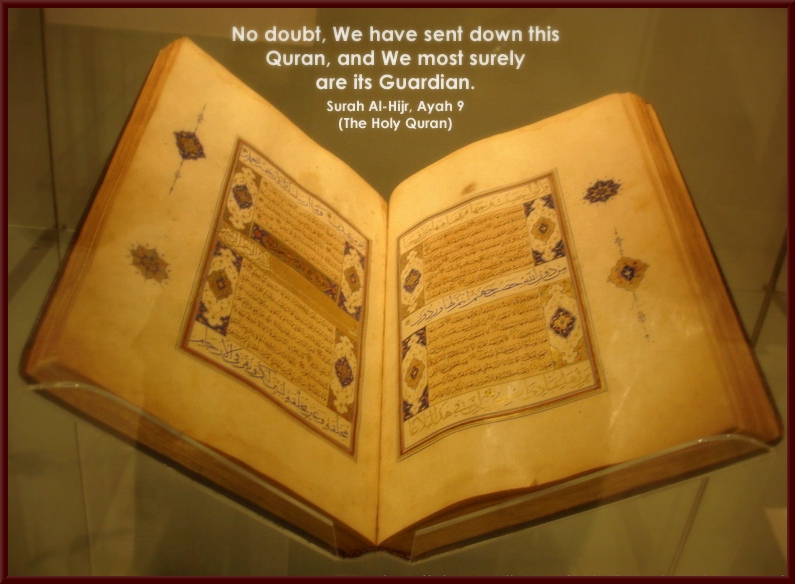


| Top of Page | Contact Mission Islam | Discussion Board | Recommended Links |